HIV Testing and HIV/AIDS Counseling Map in Japan
This page provides users with the information on HIV testing and counseling in Japan.
- Consulting service
About HIV Testing
HIV Testing
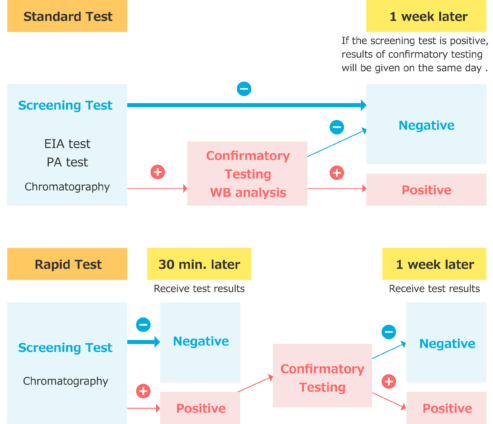
HIV testing determines whether you are infected with HIV (Human Immunodeficiency Virus), the virus that can lead to AIDS (Acquired Immunodeficiency Syndrome). HIV testing is initially performed with ‘screening tests’. If the initial test result is negative, it means ‘HIV screening-test negative’. Positive screening-test results will require follow-up (‘confirmatory’) testing to establish an HIV diagnosis. If the confirmatory test is positive, it means ‘HIV infection’. If the result is negative, it means ‘HIV negative (or that the initial screening test was a false-positive)’. Screening test results can include ‘true-positives’ due to HIV infection and ‘false-positives’ due to nonspecific reactions to the tests without the presence of HIV infection. This is why confirmatory testing is required following a positive screening test to make sure that the diagnosis is correct.
Types of HIV Tests
Once HIV enters the body, it replicates itself in the body. In reaction to the replication, the immune system produces antibodies to HIV. HIV screening tests currently and commonly used in Japan called ‘combined antigen-antibody tests’ look for evidence of these HIV-1/HIV-2 antibodies and HIV-1 antigen. As mentioned earlier, positive results from screening tests require a second test to confirm the presence of HIV. There are two types of confirmatory tests: Western Blot (WB) analysis and Nucleic acid amplification (NAT) tests. WB analysis detects HIV-1/HIV-2 antibodies, and NAT tests examine HIV genes.
How long after a possible exposure should I be tested for HIV?
When a person is infected with HIV-1, it takes about 3 weeks after
possible exposure for HIV-1 antigen to be detected in the blood,
and about 4 weeks after possible exposure for HIV antibodies to be
detected in the blood. That is to say, after 3-4 weeks of possible
exposure, a person with HIV is very likely to test positive on HIV
antigen-antibody tests and/or HIV antibody tests, currently used
for screening testing. NAT tests used for confirmatory testing can
detect HIV genes as soon as 2 weeks after exposure to the virus.
Although NAT tests are effective in diagnosing early HIV
infection, they may not detect the genes during the asymptomatic
phase of the infection.
It is important to keep in mind that your test result can come
back ‘positive’ even within 3 months of your possible
exposure to HIV, and it may mean you’re infected with the
virus. However your test result comes back negative, you’re
encouraged to get tested again at the 3-month mark because there
is a period of time after a person is infected during which they
will not test positive. The length of this period may vary between
individuals and getting re-tested can confirm that you are not
infected with HIV.
When should I take an HIV test?
You should get an HIV test if you think you have exposed yourself to risk – for example, if you have had sex without a condom. HIV infection cannot be detected without HIV tests, and the tests can screen the possibility of your HIV infection. While it takes your body up to 3 months to produce antibodies to HIV, you can still test HIV positive in the first 4 weeks after possible exposure if you’re infected with the virus. This is why you’re encouraged to get tested whenever you’re worried at all about possible infection. HIV negative test results within 4 weeks after the possible exposure can ensure that you’d been unlikely to be infected with HIV for the past 3 months prior to the tests. For your own physical and emotional well-being, we encourage you to get tested.
Getting tested in Japan
1. Where can I get an HIV test?
In Japan, there are public health centres available nationwide
which offer free, anonymous HIV testing and counseling. Other HIV
testing sites offering similar services are also available. Most
of testing sites offer HIV testing during particular hours and
days of the week (1-4 days/month) by appointment. Note that you
may need an interpreter if you’re not proficient in Japanese
because interpretation services are limited to certain testing
locations.
You can also get tested at clinics / hospitals and there will be a
charge for testing and diagnosis. *Click here
to see a list of HIV testing locations that offer interpretation
services.
2. When can I have the test result?
How long you have to wait for your test result depends on the type
of test you take. Free, anonymous HIV testing sites offer two
types of testing: standard tests and rapid tests. If your
screening test result is positive, you are to take the standard
test which includes confirmatory testing, and you will receive the
test result in 1-2 weeks. Rapid tests can produce results on the
same day of the testing (when confirmatory testing is required,
the result will be given in 1-2 weeks). Types of HIV tests you can
take vary depending on facilities. It is always a good idea to
contact the testing facility directly to make sure what testing
method is available.
If you plan to visit a clinic/hospital for HIV testing, these are
the most common procedures among health care providers. First of
all, you are to take an initial screening test, and your doctor
will give you the test result. If the test result is positive,
another blood test will be performed for confirmatory testing. It
is important to remember that if your test comes back
‘positive’, you must make sure the result is based on
screening testing or confirmatory testing. Some health care
providers also offer ‘rapid tests’ to those who
request an HIV test.
3. What does HIV negative mean?
An HIV negative test result means that at the point of the testing, your HIV test result was negative. This means that you were not infected with HIV at the time of the testing if it was done after 3 months of possible exposure. If the testing was done in the first 3 months after the exposure, we recommend you to wait at least 3 months after the exposure, and take a second test to confirm the negative result. If you are still unsure of the test results or would like to find out more about HIV/AIDS, please contact one of the multilingual telephone counseling services.
4. What does HIV positive mean?
An HIV positive test result means that the person is infected with
HIV. Without treatment, HIV can replicate quickly in the body
weakening the immune system, and this can lead to many types of
disease (the onset of AIDS). Many different types of anti-HIV
drugs with fewer side effects are now available, and some are to
be taken only once a day as a single pill. Although HIV virus
cannot be fully eradicated from the body, long-term control of HIV
replication can delay the progression of HIV infection to AIDS.
Starting anti-HIV treatment as early as possible can prevent
further damage to the immune system, and this will enable you to
live a full, healthy and active life. This is why you should visit
a health care provider for early diagnosis of your HIV status.
If your test result is positive, you will be informed about the
implication of testing HIV positive, and be referred to an HIV
specialist. If such referrals aren’t provided at the
time, there are telephone counseling services to support you. If you are concerned about any expenses
including medical costs, you can also seek consultation from your
health care provider.
Steps and processes for HIV Testing
Figure 1: From HIV Testing to Diagnosis
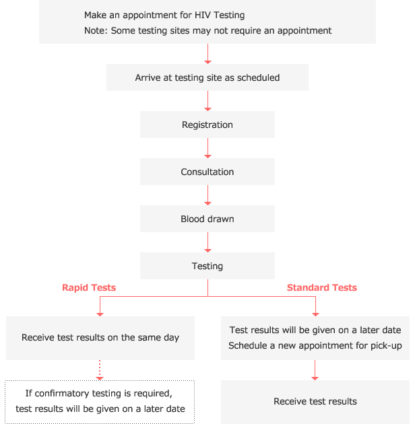
Figure 2: HIV Testing Flow Chart (Standard/Rapid Tests)
HIV testing sites that offer bi-/multi-lingual services
|
Prefecture / City |
Testing Site |
|---|---|
| Hokkaido |
CiRCLE – SAPPORO (English / Free, anonymous HIV testing / By appointment only) https://www.circle-sapporo.com/english.html |
| Tokyo |
Shinjuku-ku Public Health Centre (English, Portuguese, Spanish & Thai / Free, anonymous HIV testing) https://www.city.shinjuku.lg.jp/fukushi/file02_02_00009.html |
| Kyoto-shi |
Kyoto Industrial Health Association (English / Free, anonymous HIV testing / Reservation required)Type of HIV test : Rapid tests.<The Day-time HIV Test> Days & Hours: every Monday, 2:00 p.m. – 3:30 p.m. https://www.city.kyoto.lg.jp/hokenfukushi/page/0000271216.html< The Night-time HIV Test> Days & Hours: Monday of twice a month, 5:30p.m. – 7:00 p.m. https://www.city.kyoto.lg.jp/hokenfukushi/page/0000283313.htmlJapanese-English interpretation service is available. Contact Center for Health and Rights of Migrants (CHARM) to make a reservation for the service. Appointment request & contact (in English): CHARM TEL:06-6354-5902 10:00 a.m. – 5:00 p.m., From Monday to Thursday. |
| Osaka-shi |
Smartlife Clinic (English/Free, anonymous HIV testing) Testing site:chot CAST(Osaka communication hub of testing, counseling and support) Shinsaibashi Bldg.,4F, 1-7-3021 Higashi-shinsaibashi, Chuo-ku, Osaka-shi http://www.chotcast.com/【Test Days & Hours】 <Regular testing> Day of week:Tuesdays & Thursdays Testing items: HIV antigen & antibody, hepatitis B, syphilis Open time:18:00~20:00 <Rapid testing> Day of week: Saturdays Testing items: HIV antigen & antibody, hepatitis B, syphilis Open time:14:00~16:00 Distribution of tickets at site:12:40~ Reception time:14:00~15:30【Appointment request & Contact】 TEL:06-4708-5035 FAX:06-4708-5036 http://www.smartlifeclinic.com/ |
| Ehime |
Matsuyama-shi Public Health Centre (English & Chinese / Free, anonymous HIV & STI testing / By appointment only) Both of the appointment request for testing and the registration on test day are available in Japanese only. Consultation and counseling on test day will be offered in English or Chinese, depending on your preference. Note that bilingual staff is not always on duty.【Test Days & Hours】 Morning: 11 a.m. – 1 p.m., every Monday of the month (no testing if it falls on a holiday) Evening: 6 p.m. – 7:30 p.m., 2nd Monday of the month (no testing if it falls on a holiday) ※The test results will be given in 1 week after the testing.【Types of Testing】 HIV antibody, Syphilis and Hepatitis B & C【Appointment request & Contact】 TEL:089-911-1815 (Direct line) |
English Telephone Consultation
For any information regarding HIV or AIDS, please contact the
offices below.
Please click here.↓
English Telephone Consultation